AGILENT 83434A Lightwave Receiver 10GB/S
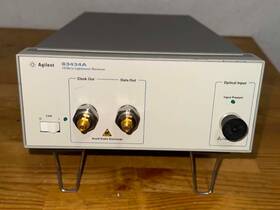
( Brand: Agilent ), ( Manufacturer Part Number: 83434A ), ( Type: Lightwave Receiver )
Review AGILENT 10gb/s Lightwave Receiver
The **Agilent 83434A 10 Gb/s Lightwave Receiver** is a high-performance, precision optical measurement instrument designed to meet the rigorous demands of modern telecommunications, fiber optic testing, and optical network validation. Engineered for accuracy and reliability, this receiver excels in evaluating high-speed optical signals across a wide range of applications, including 10 Gigabit Ethernet (10GbE), Dense Wavelength Division Multiplexing (DWDM), and other advanced optical communication systems. Its robust design ensures seamless integration into test setups, providing engineers and technicians with the tools needed to analyze signal integrity, bit error rate (BER), and optical performance metrics with exceptional precision.
At the heart of the 83434A is a high-sensitivity photodetector optimized for 10 Gb/s operation, delivering superior sensitivity and dynamic range to handle both weak and strong optical signals effectively. The receiver features a built-in pre-amplifier and equalization circuitry, which enhances signal quality by mitigating dispersion and other impairments commonly encountered in long-haul or high-speed optical links. This ensures accurate BER measurements even under challenging conditions, such as those found in real-world network deployments or during system validation phases.
The instrument s user-friendly interface and intuitive controls make it accessible for both experienced technicians and those new to optical testing. It supports a variety of input formats, including direct optical input and compatibility with Agilent s broader suite of test equipment, such as oscilloscopes and bit error rate testers, enabling comprehensive signal analysis. Additionally, the 83434A is equipped with advanced features like automatic threshold adjustment and real-time monitoring capabilities, which streamline troubleshooting and optimize testing workflows.
Built to withstand the demands of laboratory and field environments, the 83434A is housed in a durable, compact chassis that ensures stability and longevity. Its modular design allows for easy integration into existing test systems, while its compliance with industry standards such as those set by the ITU-T and IEEE guarantees consistent and repeatable results. Whether used for research and development, network certification, or troubleshooting, this receiver provides the accuracy and versatility required to ensure optimal performance in high-speed optical networks.
### Pros and Cons of buying a Agilent 83434A 10 Gb/s Lightwave Receiver
#### **Pros**
1. **High Performance and Reliability**
The Agilent 83434A is a well-established optical receiver designed for high-speed (10 Gb/s) data transmission, making it suitable for telecommunications, data centers, and network testing. Its robust design ensures stable performance in demanding environments.
2. **Compatibility with Industry Standards**
This receiver is compatible with various optical standards, including DWDM (Dense Wavelength Division Multiplexing) and CWDM (Coarse Wavelength Division Multiplexing), as well as common fiber types (single-mode and multimode). It supports standard interfaces like SFP (Small Form-factor Pluggable) transceivers, making it versatile for different network setups.
3. **Precision and Accuracy**
The 83434A is known for its high sensitivity and low bit-error rate (BER), which is critical for maintaining data integrity in high-speed networks. It can accurately measure signal quality, making it valuable for troubleshooting and performance testing.
4. **Compatibility with Agilent/Keysight Test Equipment**
As part of Agilent s (now Keysight Technologies) ecosystem, this receiver integrates seamlessly with other test and measurement instruments, such as oscilloscopes, spectrum analyzers, and network analyzers. This compatibility simplifies setup and data analysis in a lab or field environment.
5. **Durability and Longevity**
Agilent/Keysight equipment is built to last, with solid-state components and rugged construction. The 83434A is no exception, offering long-term reliability for both research and industrial applications.
6. **Support for Advanced Testing**
The receiver supports advanced testing features, such as eye-diagram analysis, BER testing, and signal-to-noise ratio (SNR) measurements. These capabilities are essential for optimizing network performance and diagnosing faults.
7. **Resale and Refurbished Market Availability**
Due to its widespread use, the 83434A is commonly found in the used or refurbished market, often at a fraction of its original cost. This makes it a cost-effective option for budget-conscious buyers.
---
#### **Cons**
1. **High Initial Cost (New Units)**
A new Agilent 83434A is expensive, often priced in the range of several thousand dollars. This can be a significant investment, especially for small businesses or individual users without large budgets.
2. **Depreciation Over Time**
While Agilent/Keysight equipment is durable, newer technologies (e.g., 40G, 100G, or beyond) may render this 10 Gb/s receiver obsolete in the long term. Upgrading may be necessary as network speeds evolve.
3. **Limited Modern Support**
Agilent/Keysight has shifted focus to newer products, and support for older models like the 83434A may be limited. Parts, firmware updates, or official warranties might be harder to obtain compared to newer instruments.
4. **Complexity for Beginners**
The 83434A is a high-end instrument with advanced features that require technical expertise to operate effectively. Users without experience in optical testing may struggle with setup, calibration, or interpretation of results.
5. **Maintenance and Calibration Requirements**
Like all precision instruments, the 83434A requires periodic calibration and maintenance to ensure accuracy. This can add to the long-term cost of ownership, especially if performed by third-party service providers.
6. **Compatibility Issues with Modern Interfaces**
While the receiver supports SFP transceivers, some newer or proprietary interfaces may not be fully compatible. Users may need additional adapters or converters, adding complexity and cost.
7. **Alternatives May Offer Better Value**
Modern alternatives, such as FPGA-based test equipment or software-defined receivers, may offer comparable or superior performance at a lower cost. These newer solutions often provide greater flexibility and programmability.
---
### **Conclusion**
The Agilent 83434A 10 Gb/s Lightwave Receiver is a high-quality, reliable instrument well-suited for professional optical testing, network diagnostics, and research applications. Its precision, compatibility with industry standards, and integration with Keysight s ecosystem make it a strong choice for users who prioritize performance and durability. However, its high cost, potential obsolescence, and complexity may not justify the investment for casual users, small businesses, or those working with newer, faster networks.
For users who require a robust, long-term solution and can justify the cost, the 83434A remains a solid option, particularly if purchased used or refurbished. Alternatively, those working with modern networks or on a tighter budget may find newer or alternative testing solutions more cost-effective.
---
### **Recommendation**
- **Buy if:**- You are a professional in telecommunications, data center operations, or optical testing who needs a reliable, high-performance receiver.
- You already own or plan to integrate it with other Keysight instruments for comprehensive network analysis.
- You are purchasing a refurbished or used unit to balance cost and performance.
- Your applications require 10 Gb/s testing and you can justify the long-term value of the equipment.
- **Avoid if:**- You are working with networks faster than 10 Gb/s (e.g., 40G, 100G, or beyond), as newer equipment may be more relevant.
- Your budget is limited, and you can find equally capable alternatives at a lower cost.
- You lack the technical expertise to operate or maintain high-end optical test equipment.
- You prioritize flexibility and programmability over legacy compatibility, in which case modern FPGA-based or software-defined solutions may be preferable.
For most professional users, the 83434A remains a valuable tool, but careful consideration of your specific needs and budget is essential before making a purchase.
Details:
Lightwave Receiver was removed from a working environment and has been tested for power. The item has some scuffs and marks from normal use.
part #: 83434a prices
- $179.00-$280.00
specifications tesmetequ:
- brand: Agilent
- mpn: 83434a
- type: Lightwave Receiver
seller tesmetequ:
- # reviews: 470
- rating: 99.7%
- city: Provo, Utah
offer tesmetequ:
- options: Ship-to-home
- quantity: 1
- best offers: True
- sold: 0
- availability: In Stock
- started: June 4, 2026
payments tesmetequ:
- credit card: Discover
- wallet: Paypal
- other
returns tesmetequ:
- policy: No Returns
shipping tesmetequ:
- service: FedEx Ground / FedEx Home Delivery
- carrier: FedEx
- transit: 5-11 Days
- type: Fixed
- class: Standard
- cost: $40.00
general tesmetequ:
- condition: Used
- Test, Measurement Inspection > Test Meters Detectors > Other Test Meters Detectors
Agilent 83434A Is Similar To:
- 800-1700nm Hp Agilent 8153a Optical Lightwave Multimeter 81531a Power Sensor (44.8% similar) SEARCHBY9 lock CE2 l victor qty 1 plan f q1 5 pounds or more 20 X14 X10 11LBS start adept 21 used. Template rounded middle right. Template rounded middle bottom. Template rounded left bottom. Testing cosmetic notes this is a used working item in good cosmetic condition that was pulled from a working...(March 29th, 2016)
- 8158b Hp Agilent Keysight Lightwave (50.7% similar) Pictures are actual item being sold. On hand and ready to ship. All offers are considered, no reasonable offer is refused. All offers considered, no reasonable offer refused. Good overall condition with some signs of use such as scuffs, scratches, blemishes or other cosmetic wear see photos. Hp ...(February 23rd, 2018)
- 1200-1600nm 11982a Agilent Lightwave Converter Opt 012 (44.7% similar) Accessories none. Please see photos. Powers up, not fully tested or calibrated. Note this is was a rack mount unit and does not have feet or stand. No cables, probes, rack ears or other accessories. Used, good condition...(August 6th, 2016)
- Hp83440c Hp Agilent Keysight Lightwave Detector Nm Opt (48.9% similar) En pd PN-83440C DC-20-GHZ-LIGHTWAVE-CONVERTER. Nod cc us LC Eng item seems to be in excellent condition. You are buying on a lightwave detector or high speed converter o e, model: 83440C with option 014 FCC PC connector dc - 20 GHZ1300 1550 NM...(July 14th, 2018)
- Hp 8509b-014 Agilent 1200 Nm-1600 Nm Lightwave Polarization Analyzer Tested (41.4% similar) Hp Agilent 8509B-014. Lightwave polarization analyzer. 1200 NM to 1600 NM, single-wave length . Option 014 st connectors. 1310 and 1550 NM fairy-Perot lasers...(August 19th, 2025)
- Agilent Keysight 8163b 81623b Lightwave Multimeter For Parts And Repair (41.4% similar) Unit is being sold as for repair...(March 16th, 2026)
